


Las Vegas maintains one of the most attractive tax landscapes in the United States. The absence of a state income tax in Nevada continues to draw residents and businesses seeking a predictable financial environment. This guide outlines the current 2025 tax rates, their components, and how they influence daily and business expenses across the city.
The combined sales tax rate in Las Vegas is 8.375%, which includes state and local portions. Major taxes include sales tax, property tax, room tax, fuel tax, and excise taxes on tobacco, alcohol, and entertainment. The average property tax rate in Clark County is approximately 0.74%, while annual increases are capped to ensure long-term stability.
Overall, Las Vegas offers a low-tax, business-friendly structure supported by clear compliance rules and capped property assessments. Unlike some jurisdictions, there are no additional city or special district taxes applied in Las Vegas. This guide will help you understand how Las Vegas taxes work, their benefits, and what makes Nevada’s system stand out in 2025.
What is Las Vegas Tax Rate
The Las Vegas tax rate defines the combined state and local taxes applied to income sources, consumer purchases, property, and specific goods or services. As of 2025, the total sales tax rate in Las Vegas is 8.375%, which consists of the state tax of 4.6% and a local rate of 3.775% added by Clark County. For residents and businesses, this structure delivers a low, stable, and transparent tax environment, supporting both economic growth and household affordability. Key taxes shaping the Las Vegas tax environment include:
- Sales Tax: 8.375% on most retail goods and services.
- Property Tax: Averaging 0.77% of assessed property value.
- Corporate Income Tax: 0%, as Nevada imposes no state corporate tax.
- Room Tax: Ranging from 10% to 13%, depending on hotel location and district.
- Fuel Tax: About 23 cents per gallon on gasoline purchases.
- Excise Taxes: $1.80 per pack of cigarettes and variable rates on alcohol.
Major Tax Types in Las Vegas
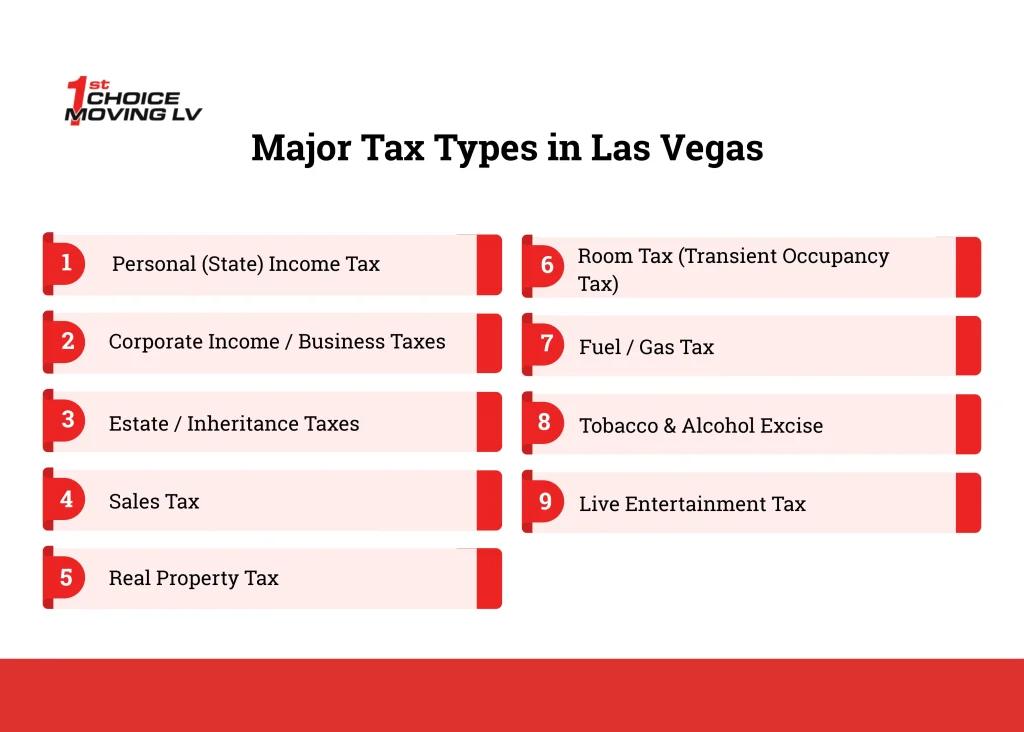
The Las Vegas tax system is built on a diverse set of taxes that fund essential public services while maintaining one of the lowest overall tax burdens in the country. Unlike most U.S. cities, Nevada imposes no state income tax, making Las Vegas particularly attractive to both individuals and corporations. Here are the primary taxes that shape the Las Vegas tax structure in 2025:
Personal (State) Income Tax
Nevada, including Las Vegas, does not impose a state personal income tax, which means residents keep more of their earnings compared to those in states like California or New York. This 0% income tax policy has been a cornerstone of Nevada’s financial appeal for decades. It supports a lower cost of living and helps attract professionals, retirees, and high-income earners seeking greater take-home pay. For example, an employee earning $80,000 in Las Vegas pays no state income tax, unlike in California, where state taxes could exceed 9%. This absence of personal income tax continues to strengthen Las Vegas as a financially efficient place to live and work.
Corporate Income / Business Taxes
Las Vegas businesses benefit from Nevada’s 0% corporate income tax, making it one of the most business-friendly states in the U.S. Companies operating here do not pay traditional state-level corporate taxes on net income. However, larger firms may be subject to two specific levies: the Commerce Tax on gross revenue exceeding a set threshold and the Modified Business Tax on payroll. These obligations are relatively small compared to other states and maintain a stable, predictable environment for corporate planning. For instance, a business generating $1 million in annual revenue in Las Vegas will often face a significantly lower tax burden than a similar company in California or Illinois.
Estate / Inheritance Taxes
Nevada does not have an estate or inheritance tax, giving Las Vegas residents a clear advantage in wealth preservation and estate planning. High-net-worth individuals and families can transfer assets without facing additional state-level estate duties. Only federal estate tax laws apply, which significantly reduces the tax complexity for estates based in Nevada. For example, while states like Oregon or Washington impose estate taxes above certain thresholds, Nevada imposes none. This absence of inheritance and estate taxes has made Las Vegas especially appealing to retirees and investors seeking to protect intergenerational wealth and maintain estate value over time.
Sales Tax
The total sales tax rate in Las Vegas is 8.375%, made up of a 4.6% Nevada state sales tax rate and an additional 3.775% local tax rate collected by Clark County. This tax applies to most retail purchases, dining, entertainment tickets, and other taxable goods and services. Some categories, such as groceries and prescription drugs, are exempt. The Nevada Department of Taxation oversees the collection and remittance process. For example, a $100 restaurant bill in Las Vegas includes roughly $8.38 in sales tax. This rate remains competitive compared to major U.S. cities and provides steady funding for public infrastructure and local services.
Real Property Tax
Property tax in Las Vegas is relatively low compared to the national average, with an effective rate of about 0.77% on assessed property value. The Clark County Assessor determines property values, and annual increases are capped at 3% for residential properties and 8% for commercial properties. For example, a home valued at $400,000 would generate about $3,080 in yearly property tax, depending on exemptions or local district assessments. This predictable cap helps homeowners and investors plan long-term budgets and prevents sudden tax spikes during market fluctuations, promoting stability in the Las Vegas housing and commercial real estate sectors.
Room Tax (Transient Occupancy Tax)
The room tax in Las Vegas applies to transient lodging such as hotels, resorts, and short-term rentals. Rates generally range between 10% and 13%, depending on the property’s location within Clark County and whether it falls under special districts like the Las Vegas Convention and Visitors Authority (LVCVA). For example, a hotel room priced at $200 per night may include around $24 in room tax. Revenue from this tax supports tourism marketing, convention facilities, and local government services. The room tax is a major revenue source in Las Vegas, reflecting the city’s reliance on its hospitality and entertainment economy.
Fuel / Gas Tax
According to the Tax Foundation, the fuel tax in Las Vegas is set at approximately 23.81 cents per gallon for gasoline, as part of Nevada’s statewide excise tax. Local county add-ons may slightly increase the final rate at the pump. This tax funds road maintenance, transportation infrastructure, and public transit development. For instance, a driver filling a 15-gallon tank pays about $3.45 in state fuel taxes. Although slightly higher than some neighboring states, the tax ensures consistent funding for highway and street improvements that support the city’s growing traffic and tourism demands.
Tobacco & Alcohol Excise
Nevada imposes excise taxes on specific products such as tobacco and alcohol. The tobacco tax is $1.80 per pack of cigarettes, while alcohol taxes vary by type and volume, ranging from $0.16 to $3.60. These taxes are collected at the wholesale level and included in the final retail price. For example, a standard 750ml bottle of liquor carries an embedded excise cost determined by alcohol content. The revenue supports state health programs and regulatory enforcement. By maintaining moderate excise rates, Nevada balances public health goals with revenue generation, ensuring fairness in consumer pricing and regulatory compliance.
Live Entertainment Tax
Las Vegas applies a Live Entertainment Tax (LET) of 9% on admission charges for most paid entertainment events, such as concerts, clubs, and shows. Venues with a seating capacity over 200 are generally subject to this tax. For example, a $150 ticket to a major concert includes $15 in LET. The Nevada Department of Taxation administers this levy, ensuring compliance across hotels and entertainment venues. Revenue from LET funds states general services while supporting oversight of Las Vegas’s expansive entertainment industry. This tax exemplifies how the city leverages its tourism base to fund operations without raising resident tax burdens.
Benefits of Las Vegas Tax System
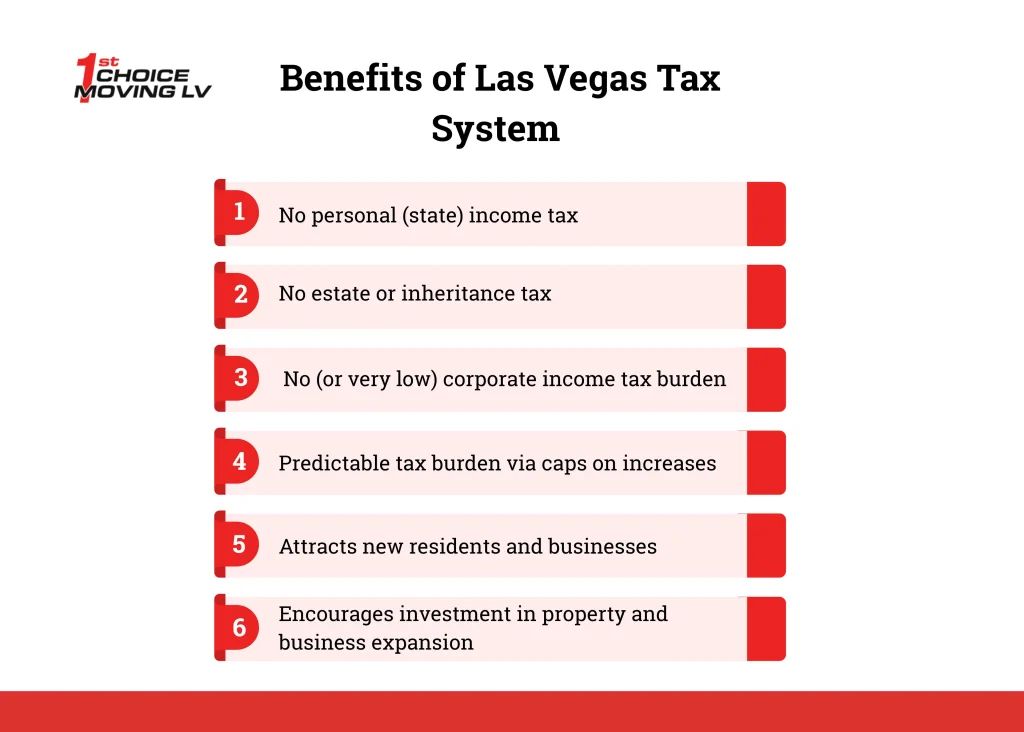
The Las Vegas tax system offers strong financial benefits for residents and businesses through Nevada’s lack of personal, corporate, and estate taxes. Property taxes remain low and predictable, with annual increases capped at 3%, ensuring lasting affordability. This stable, low-tax structure creates one of the most competitive fiscal environments in the nation, making Las Vegas a preferred destination for homeowners, retirees, and corporations seeking a cost-efficient and financially predictable place to live and operate.
No personal (state) income tax
Las Vegas residents pay no state personal income tax, allowing them to retain a greater share of earnings. For example, a professional earning $100,000 in Las Vegas keeps the full amount at the state level, while a similar earner in California could pay over 9% in state income tax. This 0% rate reduces household tax burdens, simplifies annual filings, and enhances disposable income. The policy also attracts high-income professionals, retirees, and remote workers who seek tax efficiency without sacrificing quality of life. The absence of personal income tax remains one of Nevada’s most consistent economic advantages.
No estate or inheritance tax
Nevada imposes no estate or inheritance tax, providing significant benefits for families planning wealth transfers. High-net-worth individuals can pass assets to heirs without additional state-level tax liability. This allows for simpler estate planning compared to states such as Washington or Oregon, where estate taxes can reach 10-20%. The absence of inheritance taxes has made Las Vegas an attractive retirement destination and a preferred base for trust and estate management. For example, individuals relocating from California often cite Nevada’s zero estate tax as a key factor in preserving intergenerational wealth.
No (or very low) corporate income tax burden
Nevada’s 0% corporate income tax gives Las Vegas businesses a major competitive advantage. Companies operating in the city do not pay tax on net income, which lowers overall operating costs and promotes business formation. While some firms may owe Commerce Tax or Modified Business Tax on gross revenue or payroll, these rates are minimal compared to other states. This structure has helped attract technology firms, logistics companies, and entertainment corporations. For instance, several gaming and tech businesses have chosen Las Vegas as headquarters due to its low-tax structure and regulatory efficiency.
Predictable tax burden via caps on increases
Nevada law limits property tax increases to 3% per year for residential properties and 8% for commercial properties. This predictable cap ensures stable tax growth, helping homeowners and investors plan long-term budgets without sudden spikes. For example, a home valued at $400,000 cannot see its annual property tax rise by more than about $120, preserving affordability even during housing booms. This stability also supports commercial planning, making Nevada an appealing environment for both real estate and business operations.
Attracts new residents and businesses
Nevada’s low and predictable tax system continues to attract new residents and companies from higher-tax states. With no personal or corporate income tax and capped property tax rates, the state ranked among the top five in the U.S. for business relocation and migration growth (source: national business relocation surveys). Many California-based companies have expanded into Las Vegas to reduce operational costs. Residents benefit from higher take-home pay, while businesses enjoy a more flexible and cost-effective regulatory climate that supports hiring and expansion.
Encourages investment in property and business expansion
Las Vegas’s tax structure encourages both real estate investment and business development. The combination of low property taxes, no personal or corporate income tax, and no estate tax reduces overall ownership costs and supports capital growth. For example, new property developments in Summerlin and Henderson have seen consistent investor interest due to Nevada’s tax predictability. Businesses expanding in Las Vegas often cite the absence of income tax as a driver for reinvesting profits locally. This environment strengthens long-term economic diversification and fuels steady population and business growth.
How is Tax Compliance, Administration, and Enforcement Handled?
Tax compliance in Las Vegas and throughout Nevada is overseen by the Nevada Department of Taxation, which manages registration, tax collection, filing, and auditing for all businesses. Companies must collect and remit applicable taxes on set schedules, while out-of-state sellers are required to comply with economic nexus rules once sales or transaction thresholds are met. This framework ensures consistent reporting, accurate remittance, and fair enforcement across all taxable activities within the state.
Tax Collection & Remittance
Businesses in Las Vegas are required to collect sales tax from consumers at the point of sale and remit those funds to the Nevada Department of Taxation. The process involves maintaining accurate sales records, filing returns, and submitting collected taxes either monthly, quarterly, or annually based on business volume. Most retailers and service providers file quarterly, ensuring regular remittance cycles. For example, a small business selling taxable goods must collect 8.375% sales tax and remit it to the state by the assigned due date. This structured system guarantees timely revenue flow and simplifies compliance through Nevada’s online filing portal.
Filing Frequency & Thresholds
The filing frequency for Nevada taxes is based on a business’s total taxable sales or revenue. Companies with monthly taxable sales exceeding $10,000 must file monthly returns, while those with lower volumes typically file quarterly, and small operations may qualify for annual filings. For example, a retailer earning $25,000 per month must report monthly, whereas a boutique earning $8,000 may report quarterly. The Nevada Department of Taxation assigns filing schedules at registration to match actual sales activity. This threshold-based system provides flexibility for smaller enterprises while ensuring consistent, timely compliance from larger firms across the state.
Audits & Penalties
The Nevada Department of Taxation performs periodic audits to confirm compliance and verify accurate reporting. Audits can be random or triggered by discrepancies in filings. If a business underreports or delays payment, penalties apply, typically 5% per month on the unpaid balance, up to a statutory limit. Additional interest may accrue until the full amount is paid. For example, if a business fails to remit $2,000 in sales tax on time, it could owe an additional $100 per month in penalties. These measures ensure fairness in tax collection and encourage consistent, timely reporting across all business sectors in Las Vegas.
Nexus & Out-of-State Seller Obligations
Nevada’s economic nexus rules require out-of-state sellers to collect and remit sales tax if they exceed $100,000 in annual sales or 200 separate transactions within the state. This policy applies to e-commerce platforms, marketplace facilitators, and remote sellers. For example, an online retailer generating $150,000 in sales to Nevada customers must register with the Department of Taxation and remit applicable sales taxes. This ensures fair competition between local and remote businesses. Nevada’s streamlined online registration system simplifies compliance and enables remote sellers to file electronically without establishing physical presence.
How Las Vegas Tax Rates Affect Your Moving Costs
Moving to Las Vegas offers clear financial benefits, including no personal income tax, no corporate tax, and predictable property tax rates. Together, these factors create a stable and affordable environment for individuals and businesses considering relocation. However, several local taxes can still influence short-term moving expenses. The sales tax of 8.375% applies to most purchases, including furniture, appliances, and moving supplies, slightly increasing setup costs for new residents.
For homeowners, the average property tax rate of 0.77% affects long-term housing expenses, while room taxes may add to temporary accommodation costs during relocation. Businesses must also account for local business license fees and potential compliance registration costs. Despite these minor expenses, the overall tax burden in Las Vegas remains among the lowest in the nation, helping residents and companies recover moving costs quickly.
With this balance of low recurring taxes and economic predictability, it is no surprise that tens of thousands of people move to Las Vegas each year in search of better opportunities and an affordable lifestyle. If you are among them and planning your move to Las Vegas, partnering with a trusted Las Vegas moving company can make all the difference. Professional Las Vegas movers provide local expertise, reliable logistics, and secure handling of your belongings, ensuring a smooth and stress-free relocation experience from start to finish. Whether you are moving across town or from another state, the right team can help you settle into your new home with confidence and ease.


